
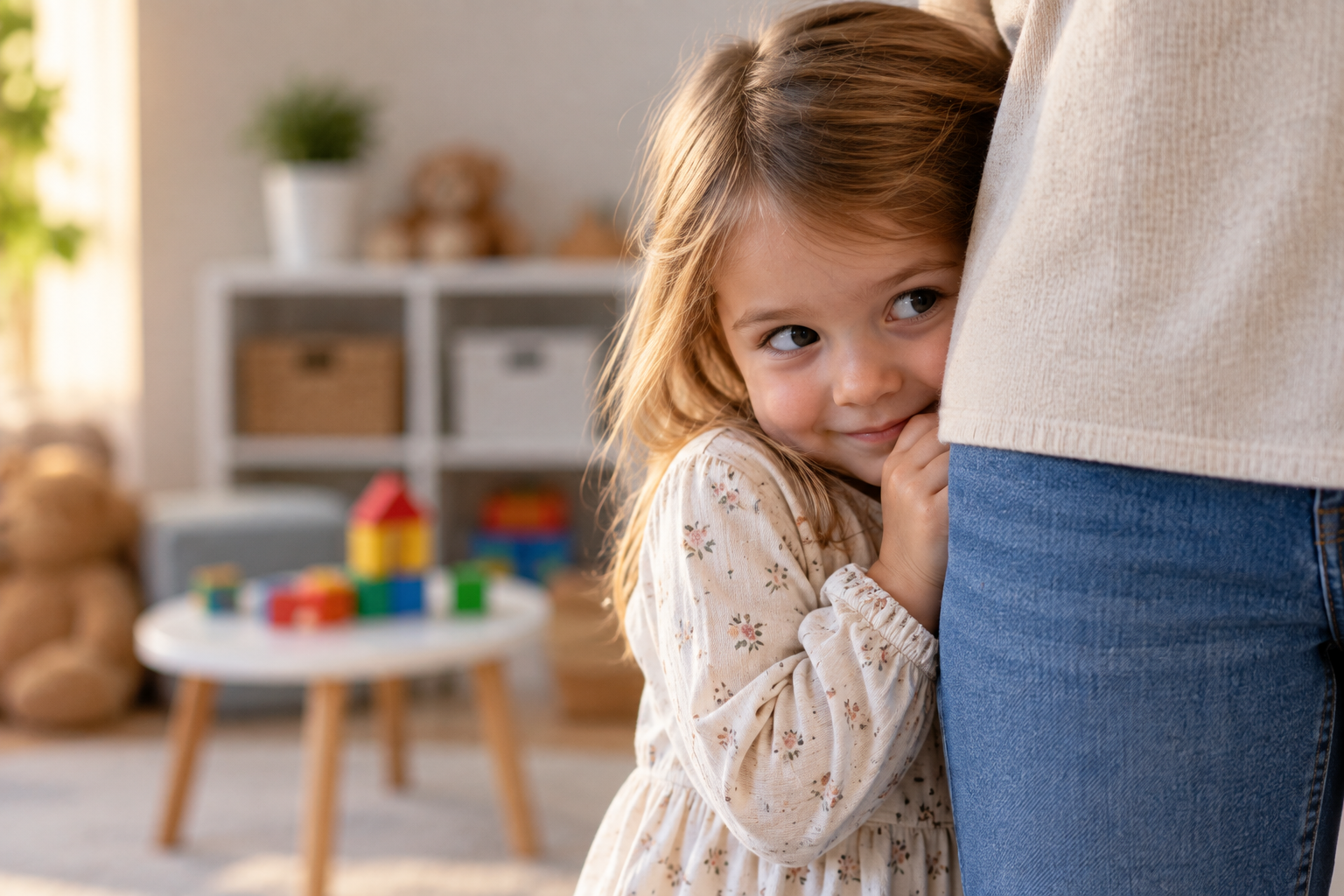
Building confidence in a shy child does not mean trying to make them more outgoing. Confidence grows through small successful experiences, preparation for unfamiliar situations, opportunities for independence and support that respects the child’s temperament.
Parents can help by practicing social situations, encouraging manageable steps and noticing effort rather than treating extroverted behavior as the goal. A child does not need to become the loudest person in the room to feel capable around other people.
Understand That Shyness Is Not a Flaw
Some children simply need more time before they feel comfortable with unfamiliar people or places. They may be quiet at a birthday party, watch a group before joining or hesitate to answer an adult they have just met.
That does not automatically mean they lack confidence.
A child can be reserved around strangers but talk freely at home, feel proud of their abilities and participate enthusiastically in activities they know well. Shyness and low self-esteem are not the same thing.
The American Psychological Association describes shyness in the context of temperament and notes that the trait itself is not inherently good or bad. The goal, then, is not to erase a child’s natural style but to help them do things they want or need to do even when they initially feel uncomfortable. American Psychological Association — Why are some kids shy?
Confidence should make a shy child feel more capable, not pressure them to perform a different personality.
Avoid Labeling Your Child as “Shy”
Repeatedly introducing a child with comments such as “She’s shy,” “He never talks to anyone” or “She’s our quiet one” can turn a behavior in certain situations into an identity.
Try describing what is happening instead.
You might say:
- “She sometimes needs a little time to warm up.”
- “He likes to watch for a while before joining.”
- “She’ll answer when she’s ready.”
Children’s Hospital of Philadelphia recommends being careful about labeling children as shy and suggests a “slow to warm” framing for children who need more time to adjust to unfamiliar people or situations. Children’s Hospital of Philadelphia — Shyness in Kids
This does not mean pretending the child never feels shy. It simply leaves room for their behavior to change from one situation to another.
Start With Small Social Steps
A child who struggles to speak to unfamiliar people does not need to begin by performing in front of a large group.
Choose a step that is slightly challenging but realistic.
For example, a child might:
- say hello to a familiar neighbor;
- ask a teacher one question;
- order their own drink;
- join a game for five minutes;
- greet another child at practice;
- invite one friend home.
Once a step becomes easier, repeat it and gradually increase the challenge.
The American Academy of Pediatrics’ HealthyChildren resource specifically recommends small social “baby steps,” role-playing beforehand and praise for progress when helping a child who is very shy around unfamiliar people. HealthyChildren — Helping a shy child around strangers
The aim is not to remove every uncomfortable feeling before the child acts. It is to give them repeated experiences of discovering that they can manage a situation even when it feels awkward at first.
Prepare for New Situations in Advance
Uncertainty can make a new social situation feel harder than it needs to be.
Before a birthday party, new class, first sports practice or family gathering, explain what the child can expect:
- where you are going;
- who is likely to be there;
- what will happen first;
- approximately how long you will stay;
- what the child can do when they arrive;
- who they can come to if they need help.
Preparation turns an unfamiliar situation into something the child can picture.
You do not need to plan every conversation in advance. The point is simply to reduce unnecessary uncertainty.
For example, before a party you might say, “When we arrive, we’ll say hello to Mia’s parents. You can stay with me for a few minutes and look around. Then we can find out what the other kids are doing.”
That gives the child a starting point without demanding immediate participation.
Practice Social Situations With Role-Play
Children often find social situations easier when the first attempt does not happen in public.
Use simple role-play at home to practice moments that regularly feel difficult.
You can rehearse:
- introducing yourself;
- asking to join a game;
- ordering food;
- asking an adult for help;
- answering a simple question;
- inviting another child to play;
- responding when someone says no.
Take turns playing different roles.
For example:
“Can I play too?”
“Do you want to build this with me?”
“Can you show me where this goes?”
Keep the practice relaxed. The child does not need to memorize a perfect script. Having two or three familiar phrases available can be enough to make the real interaction feel less unpredictable.
Build Confidence Through Their Strengths
Social confidence does not have to begin with talking to strangers.
A child may first develop a strong sense of competence through drawing, reading, building, music, animals, sports, puzzles or another activity they genuinely enjoy.
Those interests can then create easier opportunities for connection.
A child who finds free conversation uncomfortable may have much less trouble talking to another child while they are both building with LEGO, drawing the same subject or practicing a sport.
HealthyChildren also recommends choosing activities based on a shy child’s interests and strengths because shared interests can give children a natural starting point for conversations and relationships.
There is no need to fill the week with clubs in the hope that constant exposure will create confidence. One activity where the child feels capable and interested can be more useful than several they dislike.
Give Them Chances to Do Things Independently
Confidence comes partly from accumulating evidence: “I did that myself.”
Look for small everyday situations where your child can take the lead.
Depending on age, that might mean:
- asking a store employee a question;
- paying for a small purchase;
- requesting something they need;
- choosing an item and speaking to the cashier;
- solving a minor problem before you step in;
- handling a small household responsibility;
- working out a disagreement with another child with some coaching.
It can be tempting to speak for a hesitant child because it is faster and less uncomfortable. But if an adult always takes over the moment the child pauses, the child loses the chance to discover what they can do.
Support first, let them attempt the task and gradually reduce your help.
Independence gives a child real evidence that they can cope.
Model Confident Social Behavior
Children learn a great deal by watching adults handle ordinary interactions.
Let your child see you:
- greet someone you do not know well;
- ask for directions;
- make a little small talk;
- ask an employee for help;
- recover calmly from an awkward moment;
- admit when you make a mistake.
You do not need to announce that you are teaching confidence. Everyday examples are often more useful than telling a child, “You need to be more confident.”
HealthyChildren includes modeling confident social behavior among its recommendations for parents of shy children.
Praise Effort, Not Just Outgoing Behavior
If praise only appears when a child is unusually talkative, the unintended message can be that being outgoing is what makes the parent proud.
Notice the difficult part they attempted instead.
For example:
“I noticed you were nervous, but you still asked if you could join the game.”
“You didn’t know anyone when we arrived, and you decided to stay for the activity.”
“You ordered by yourself even though you felt uncomfortable.”
That is more useful than saying, “See? There was nothing to be nervous about.”
The second response dismisses what the child actually experienced. The first recognizes the discomfort and the effort it took to act anyway.
Praise the brave part of the attempt, not how extroverted the child looked.
Give Your Child Time to Warm Up
Some children need to observe before participating.
At a new playground, class or family gathering, they may want to stay close to a parent for a few minutes, watch what others are doing and join when the situation feels more familiar.
Allowing a short warm-up period is not the same as letting a child avoid every uncomfortable interaction.
If possible, create a bridge into participation. You might walk around the room together, find one familiar person, look at the activity or help the child identify one thing they would like to try.
CHOP recommends preparation, practice, positive feedback and validation for children who are slow to warm, rather than pushing them into immediate interaction.
The aim is gradual participation, not instant performance.
Help With Friendships One Step at a Time
A large group may be intimidating even when one-on-one interaction feels manageable.
Start smaller.
A short playdate with one familiar child can give a shy child more space to practice conversation and cooperation than a crowded party. Structured activities can also be easier because the children already have something to do together.
Parents can coach specific friendship skills, such as:
- asking to join a game;
- suggesting an activity;
- taking turns;
- dealing with a minor disagreement;
- responding to rejection;
- asking for help.
Do not make “having lots of friends” the measure of success. Some children naturally prefer one or two close friendships to a large social circle.
A small circle of good friends can be a perfectly healthy social world.
What Not to Do With a Shy Child
Pressure can make a child more self-conscious rather than more confident.
Try to avoid:
- forcing a child to perform socially “so they’ll get used to it”;
- teasing them about being quiet;
- comparing them with an outgoing sibling;
- answering for them before they have time to respond;
- introducing them to everyone as “the shy one”;
- rewarding only highly outgoing behavior;
- treating a quiet personality as a problem.
There is also a difference between encouragement and suddenly placing a child in a situation far beyond what they can currently handle.
Confidence usually develops through manageable challenges and repetition, not through one dramatic test of bravery.
When Shyness May Need Extra Support
Shyness itself does not require treatment. Some children simply take longer to become comfortable in social situations and continue to prefer smaller groups or familiar people.
It is worth discussing the situation with the child’s pediatrician or a qualified mental-health professional if fear or avoidance is substantially interfering with everyday life.
Examples might include a child who:
- regularly avoids school or activities because of fear;
- becomes extremely distressed before ordinary social situations;
- is unable to speak in situations where communication is necessary;
- cannot develop relationships even after having time to adjust;
- repeatedly gives up activities they want to do because of social fear;
- appears persistently anxious or distressed.
HealthyChildren recommends checking with a pediatrician when a child’s reactions to strangers or separation cause substantial distress or do not seem to improve.
These signs do not by themselves establish social anxiety disorder, selective mutism, autism or another diagnosis. A professional can look at the child’s age, development, behavior across different settings and the degree to which the difficulty affects daily life.
Confidence does not require a shy child to become the loudest person in the room. The goal is to help them trust that they can handle new people and situations even when they need a little time at first. Small steps, repeated opportunities and support without pressure give that confidence room to grow.